Antenna Projects
Here you'll find documentation for my various homebrew antenna projects, including designs of others and my own, performance notes, and lessons learned.
Current Projects
WE7OMG Pockrus Open Stub J-Pole (Joystick™)
- Designer: WE7OMG (Carl Pokrus) / NT1K (Jeffrey Bail)
- Type: Dual-band 2m/70cm Open-Stub, Half-Wave J-Pole
Technical Overview
Technically, the Pockrus™ J-pole Joystick™ antenna is a dual-band (2 meters and 70 cm) open-stub, half-wave J-pole antenna. As a vertical radiator, it has a flattened-donut omnidirectional pattern, sending a radio signal fairly equally in all directions parallel to the earth.
Construction
- Materials:
- Solid aluminum rod stock (3/8" diameter)
- Aluminum angle brackets for mounting
- Stainless steel nuts with Loctite™ to prevent accidental loosening
- Threaded rods for secure assembly
- Connector: SO-239 (UHF) stud for connection to 50-ohm coaxial cable
- Design Features:
- Open Stub design for improved bandwidth and performance
- Pre-drilled mounting holes for easy installation
- Weather-resistant construction with proper sealing to the SO-239 connector
Performance
- 2m Band (144-148 MHz):
- SWR: 1.1:1 or better
- Gain: 2.6 dBi (measured over real earth)
- Radiation: Flattened-donut omnidirectional pattern
- 70cm Band (440-450 MHz):
- SWR: 1.3:1 or better
- Gain: 5.2 dBi (measured over real earth)
- Radiation: Flattened-donut omnidirectional pattern
- Power Handling: 1500W PEP
- Bandwidth: Covers entire 2m and 70cm bands, compatible with GMRS frequencies
Note on Gain Measurements: The gain values listed are measured over real earth conditions. When comparing antenna gains, it's important to understand that a dipole over earth at optimum height has approximately 8.5 dBi gain (not the often-cited 2.15 dB over isotropic). The J-pole's gain of ~2.6 dBi on 2m is comparable to a 1/4 wave ground plane antenna (2.69 dBi). For more technical details on J-pole gain and performance, see W8JI's End-Fed Vertical and J-pole Analysis.
Features
- No radials or ground plane needed
- Omnidirectional radiation pattern (flattened-donut)
- Improved bandwidth over traditional copper J-Pole designs
- Simple construction with common materials sourced from local hardware stores and online
- Secure assembly with stainless steel hardware and thread locker
- Usage:
- Local repeater access
- APRS operation/ Winlink
- Simplex communications
- Emergency communications
- References:
- Images:
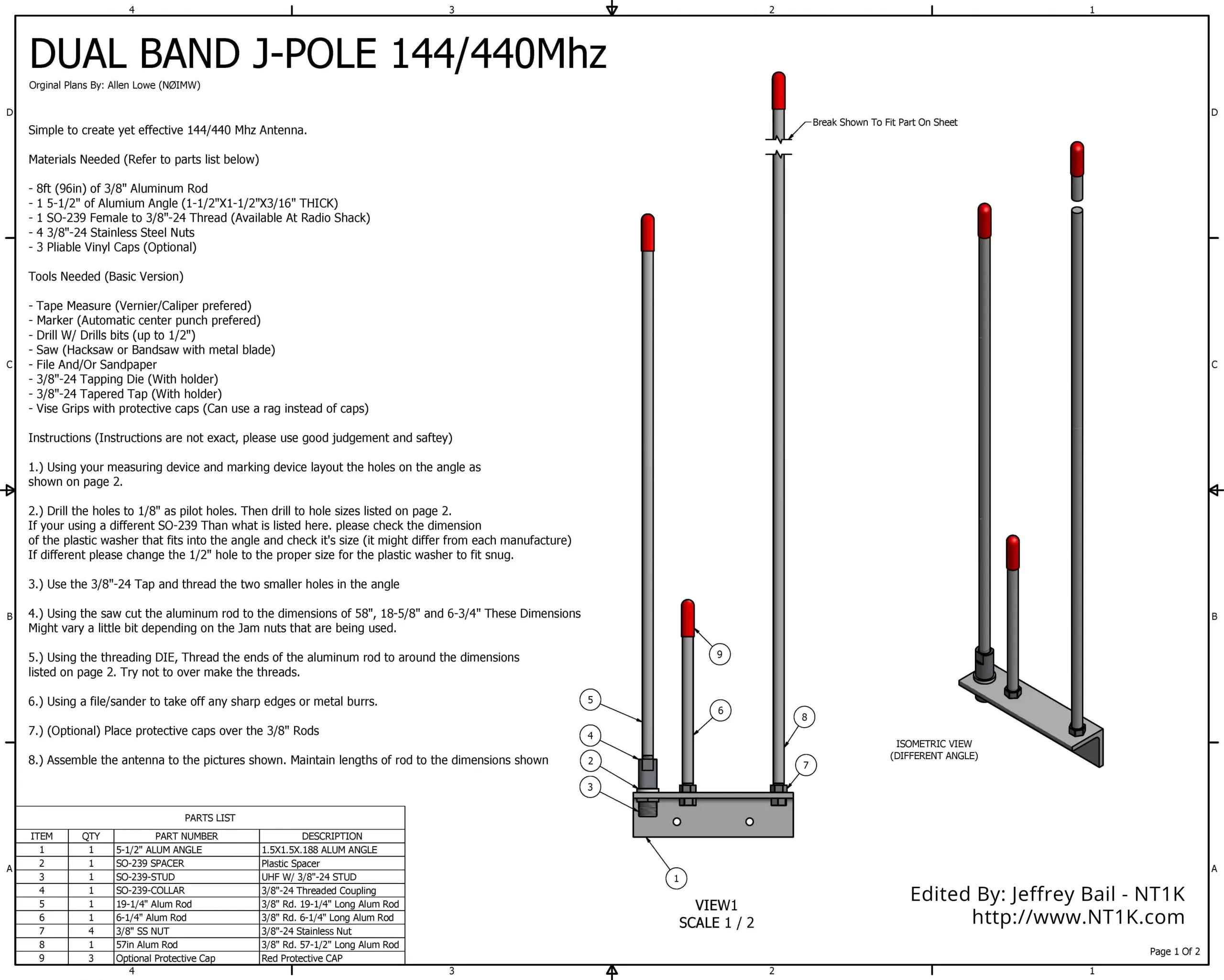
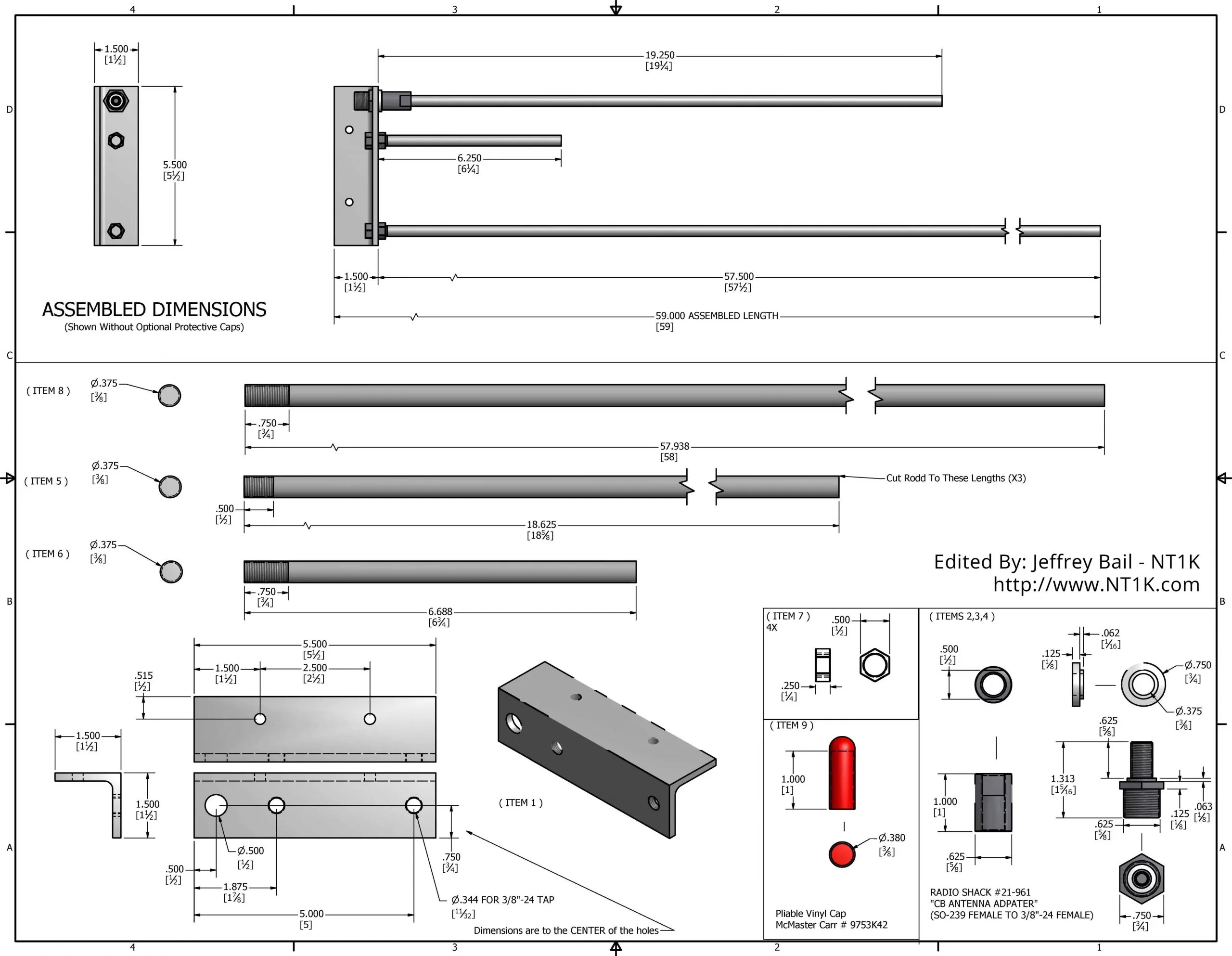 Images courtesy of NT1K.com
Installation
- Install the J-Pole on a 1/2 wave vertical (12.5 ft or 3.8 m)
- Use a 50 ohm coaxial cable to connect the J-Pole to the radio
- Wrap the coaxial cable in 5 turns of LMR-400 to create a ugly but effective RF choke, this helps keep RF from returning to the radio. This antenna suffers from common mode current, so the RF choke is important.
End-Fed Half Wave (EFHW) Antenna
- 40m-10m multiband configuration
- Homebrew 49:1 unun
- Lightweight and portable for field operations
Magnetic Loop Antenna
- 20m-10m coverage
- Vacuum variable capacitor tuning
- Remote tuning system in development
Yagi Antennas
- 2m/70cm dual-band Yagi for satellite work
- Portable 6m Yagi for VHF contests
Future Projects
- NVIS antenna system for regional communications
- Hexbeam for HF DXing
- Portable vertical antenna for SOTA activations
Resources
Last Updated: October 2025